Black or green streaking
That's organic growth — mold, mildew or algae thriving in Florida humidity, usually worst on the shaded side. It needs killing and cleaning, not just pressure. Blasting it off without treating it means it's back in months.
 GROUNDWORKSPAVERS & TURF
Call now
(321) 586-9227
GROUNDWORKSPAVERS & TURF
Call now
(321) 586-9227
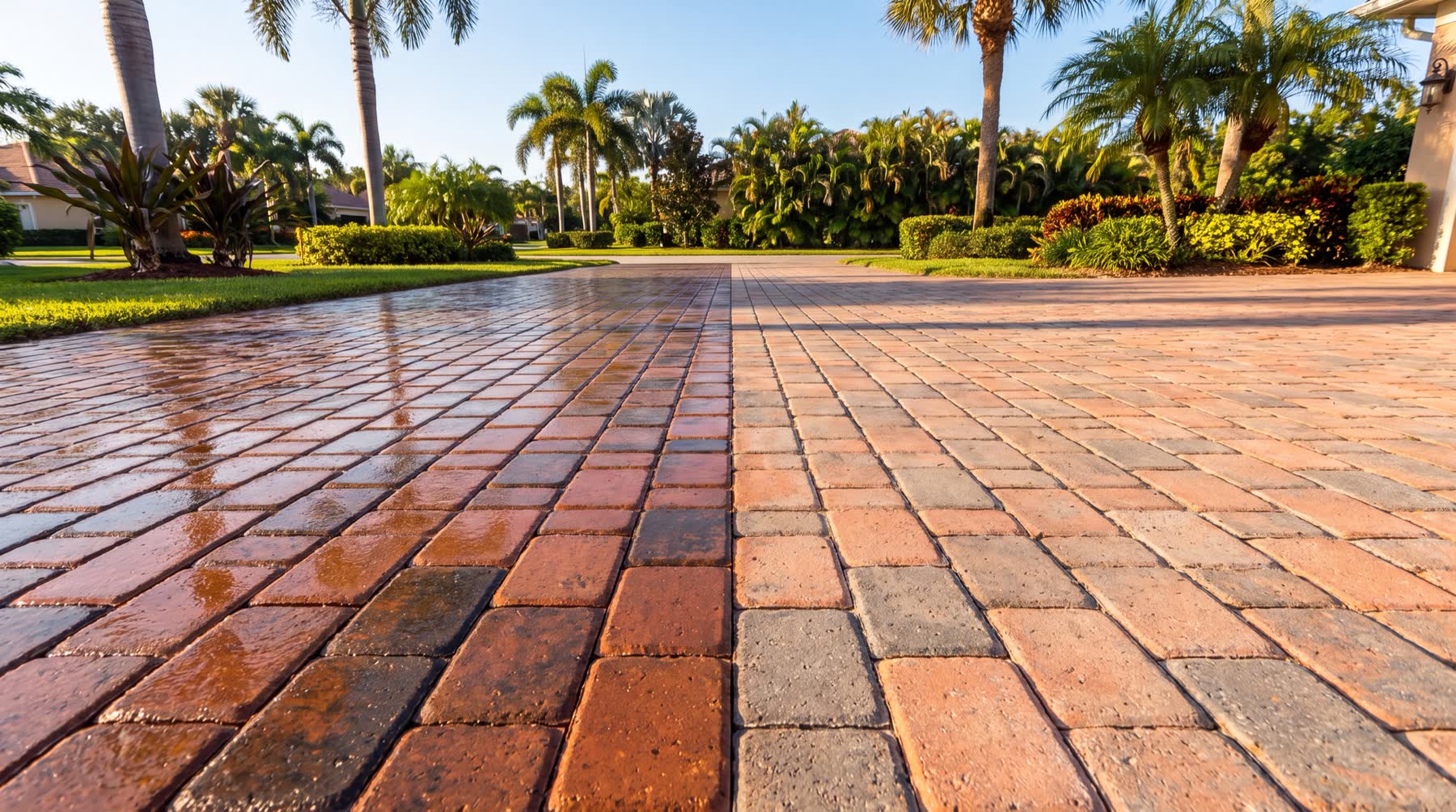
Paver cleaning & sealing — Brevard County
Most of the pavers we clean and seal were installed by somebody else years ago. If they're sound, we can bring them back — and if they aren't, we'll tell you that instead of sealing over it.
Recent work
Drag or swipe to browse · tap a photo to open it
Watch a real one
Levi walks a real Brevard driveway through the whole thing — the wash, the re-sand, the seal — in under a minute. Sound on for the walkthrough.
Most of our sealing work is on pavers somebody else laid — jobs that start exactly like this one.
Get the same estimate — freeStart here
Nobody searches for "paver sealing." They search for the thing they're looking at. Find yours.
That's organic growth — mold, mildew or algae thriving in Florida humidity, usually worst on the shaded side. It needs killing and cleaning, not just pressure. Blasting it off without treating it means it's back in months.
Two very different causes. Efflorescence is mineral salt migrating out of the concrete and is normal on newer pavers. A cloudy film over a previously sealed surface is usually moisture trapped under the sealer. The fix is different for each, so it gets diagnosed before anything is applied.
Open joints let the surface lose its interlock, and that's when movement starts. Re-sanding is part of the sealing process, not an extra — sealing over empty joints locks in the problem.
Florida UV fades exposed concrete pavers over the years. Cleaning brings back more than people expect, and a sealer restores and holds the color depth.
Both live in loose or empty joint sand. Cleaning out and refilling the joints removes the habitat, and that's what actually gets a lasting result.
Usually sealed too soon, sealed over trapped moisture, or sealed over efflorescence. It's fixable, but it's a strip-and-redo conversation rather than another coat on top.
What the job looks like
The cleaning and the sand are most of the work. The sealer is the last twenty minutes.
Are the pavers structurally sound? Have they been sealed before, and with what? Is there efflorescence or organic growth? The answers change the whole scope, so we don't quote sealing sight-unseen.
Surface cleaning plus treatment for mold, mildew and algae — so it doesn't come straight back — and stain work where it's needed.
Old, contaminated or washed-out joint sand comes out and fresh joint sand goes in, swept and set. This is the step that restores interlock and starves out ants and weeds.
The surface has to be genuinely dry before anything gets applied. This is the step that gets rushed on bad jobs, and it's the one that causes hazing.
Wet-look or matte, applied evenly at the correct rate, with grip additive where the surface calls for it.
We'll tell you exactly how long to stay off it and when furniture and vehicles can come back.
The rules we won't break
Sealing failures are nearly always timing failures. These are the ones worth turning work away over.
If your job hits one of these, we'll tell you what has to happen first and when to call us back.
Free estimate
Text a picture and we'll tell you what you're looking at and whether sealing is the right move.
Choosing a finish
This is the decision people regret, because one direction is much easier to go than the other.
| Wet-look / enhanced | Matte / natural | |
|---|---|---|
| The look | Deepens and enriches the color, like after rain | Keeps the stone looking like stone |
| Choose it if | You want the color to pop and the surface to read rich | You want protection without changing the look |
| Sheen | Noticeable, glossy in sun | Little to none |
| Reversibility | Hard to undo — going back means stripping | Easier to change direction later |
| Pool decks | Ask about slip before choosing this | Generally the safer default underfoot |
Going from matte to wet-look later is easy. Going from wet-look back to natural means stripping the surface, so it's worth seeing both on your actual pavers before you decide. We'll do a test area.
Pool decks
Worth being blunt about, because this one is a safety issue rather than an aesthetic one.
Questions
Not at all. Most of our sealing customers had their pavers installed years ago by someone else. If the surface is sound we can clean, re-sand and seal it.
It depends on the product used, the sun and traffic the area takes, and whether it's a driveway or a shaded patio. We'll tell you what to expect for your surface and the honest signs to watch for rather than a number that fits everybody.
Usually. Hazy, blotchy or peeling sealer generally means moisture or contamination got trapped underneath, and the fix is stripping it back and starting properly. We'll look and tell you whether it's a strip or a recoat.
It dramatically helps, because properly filled and set joints remove the loose sand weeds and ants live in. Nothing stops a seed landing on the surface, so treat it as a big reduction rather than a permanent end to it.
On a surface with life left in it, yes — it holds the color against Florida UV, resists staining, and keeps the joints intact, which is the structural part. On a surface that's failing underneath, no — that's spending money to hide a problem, and we'll say so.
Where we seal
We didn't have to lay them to seal them — these pages cover every city we work.
Fastest answer
Most questions we can answer on the phone in two minutes, and if we need to see it we'll book the walkthrough while you're on the line.
(321) 586-9227Or text a photo of the space — that's often the fastest way to get a real answer. Prefer email? info@groundworkspaversandturf.com.
Free estimate
Tell us roughly how big the area is and when it was last sealed, if you know.
Five quick questions — then you're booked in and someone reaches out within 5 minutes. Prefer to talk? Call (321) 586-9227.