
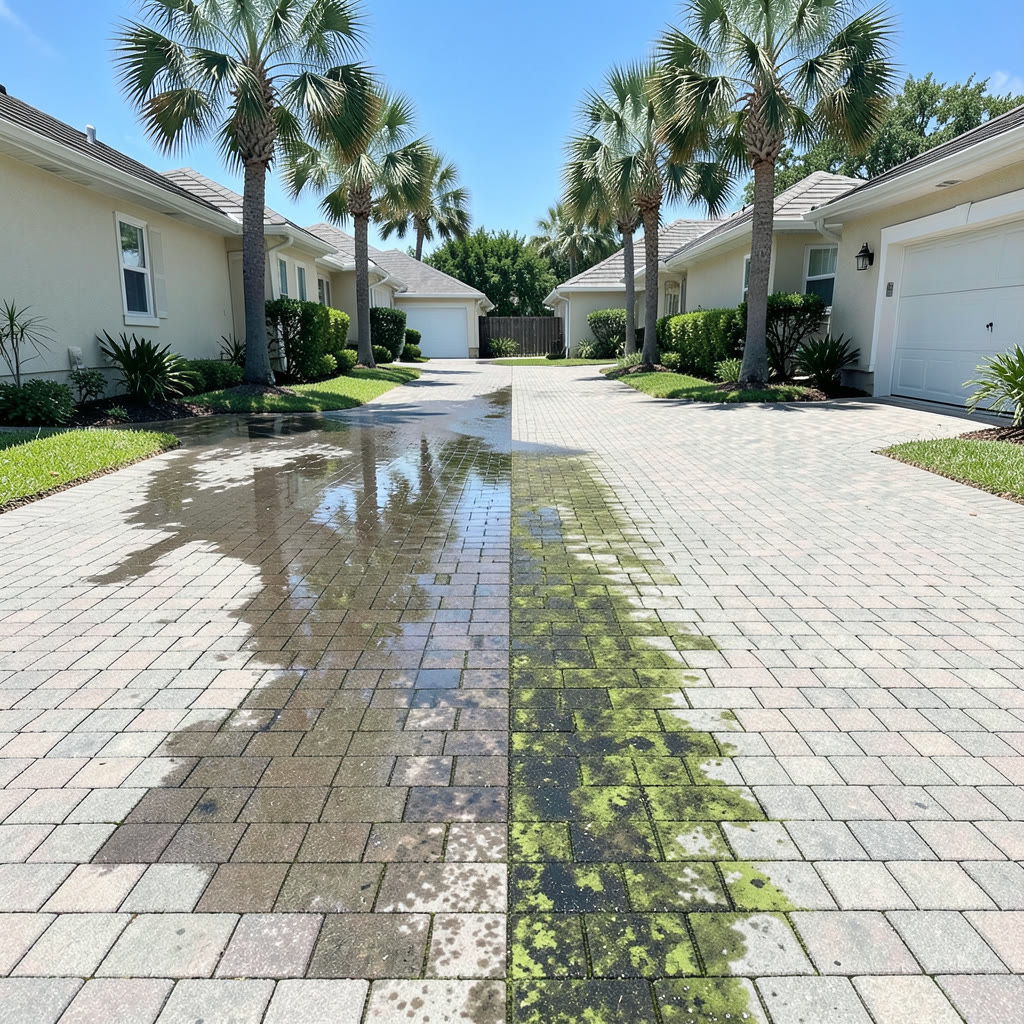
The short answer
Why can't you seal pavers before you wash them?
Sealer locks in whatever is on the surface the moment it goes down. If there's algae film, dirt, or a haze of grime under it, the sealer traps that in instead of covering clean pavers. Washing first is what makes the sealer's job possible — it's not a nice-to-have step, it's the one that makes every step after it worth doing.
Washing also does something sealer can't: it opens the surface. Pressure lifts the grime out of the texture of the paver, which is exactly what lets sealer soak in and bond instead of just sitting on top like a coat of paint. Seal first and you're sealing in the dirt along with the surface.
What actually happens if you seal over a dirty or damp surface?
Two different problems, same bad result. Seal over dirt or algae and you lock in a haze — a cloudy or blotchy look that doesn't come out, because now it's under a layer of sealer instead of on top of the pavers where you could still wash it off. That's not a texture problem, it's permanent until the sealer wears off or gets stripped.
Seal over pavers that are still damp underneath and you get a different failure: the moisture has nowhere to go, so it pushes back up against the sealer from below. That shows up as white haze, bubbling, or sealer that peels in sheets down the line, long after the crew that did the work is gone.
Why does re-sanding have to happen in between?
Washing and re-sanding go together for pavers, in a way they don't for plain concrete. The same pressure that lifts grime out of the paver joints also lifts out the sand that's holding those joints together. Skip re-sanding and you're left with open joints — which means pavers that shift underfoot and gaps where weeds and ants move in.
Re-sanding has to happen before sealing, not after, because a lot of paver sealers are built to lock the joint sand in place along with the paver surface. Seal first and then try to re-sand, and the new sand won't bond the way it's supposed to — you'll be adding a step that doesn't actually hold.
How long do pavers need to dry before sealing in Florida?
Long enough to dry all the way through, not just on top. Florida humidity is the catch — a paver surface can look bone dry while there's still moisture sitting underneath it, especially on joints that just got packed with new sand. Sealing over that gets you the trapped-moisture problems we already covered, not a shortcut.
We don't seal off a guess. We check the surface and give it the time it actually needs before we come back for that step, which is part of why washing and sealing are usually two separate visits, not one. Rushing it to squeeze the whole job into one visit is how a good wash turns into a cloudy seal job.
Is there ever a case where washing alone is the right call?
Sometimes, yes — and we'll tell you when it is. If a house exterior, a plain concrete driveway, or a pool cage deck just needs to look clean again, a wash on its own is a complete job. There's no joint sand to lose and nothing underneath that needs protecting the way a paver system does.
Even on pavers, if the joints are still tight and full and you're not ready to seal, washing alone can be the honest answer — we're not going to talk you into re-sanding joints that don't need it. What we won't do is seal pavers with loose or missing joint sand and call it finished, because that's sealing over a problem instead of fixing one.
Free estimate
Rather just ask us?
Two minutes on the phone usually settles it — or send a photo of the space.
Related questions
What people ask next.
Can I seal pavers myself right after you wash them?
We'd tell you not to. Even after washing, the joints usually need re-sanding, and the pavers need real dry time underneath, not just a dry-looking surface. Sealing on top of freshly washed, unsanded, still-damp pavers is exactly the combination that causes haze and peeling later.
Why did my paver sealer come out cloudy or white?
Almost always trapped moisture. If the pavers weren't fully dry all the way through before the sealer went down, that moisture has nowhere to go and pushes back up through the finish. It's a prep problem, not a bad batch of sealer.
Do you have to re-sand every single time you wash pavers, or only sometimes?
Every time, if sealing is part of the plan. Washing pulls some sand out of the joints no matter how careful the pass is — it's what the pressure is doing to the grime that's also holding onto the sand. We check the joints after every wash and re-sand before we ever talk about sealing.
Do I have to seal my pavers, or can I just have them washed?
You don't have to seal. A wash on its own gets pavers clean and, if the joints are already solid, that can be the whole job. Skipping the seal just means the color and the clean won't hold as long — the honest tradeoff, not a problem with the wash itself.
Keep reading
Where to go from here.
Fastest answer
Instant quote — give us a call.
Most questions we can answer on the phone in two minutes, and if we need to see it we'll book the walkthrough while you're on the line.
(321) 586-9227Or text a photo of the space — that's often the fastest way to get a real answer. Prefer email? info@groundworkspaversandturf.com.
Free estimate
Get a written number instead.
Free walkthrough, itemized estimate, no pressure.
Five quick questions — then you're booked in and someone reaches out within 5 minutes. Prefer to talk? Call (321) 586-9227.