
The short answer
What wears sealer down in a Florida climate?
UV is the big one. Florida sun hits pavers with more direct overhead light for more months of the year than most of the country gets, and UV breaks down the resins in sealer the same way it breaks down anything left outside — the polymer chain degrades and the finish starts to look flat and pale before it does anything you'd call "failing."
Near the beaches, salt air adds a second front. Salt crystals ride the wind, land on the surface, and work into the microscopic texture of the sealer coat. Combine that with sprinklers or rain sitting on the surface and you get a slow chemical and physical wearing-down that inland driveways don't deal with at the same rate.
Traffic matters too — foot traffic on a pool deck wears differently than tire traffic on a driveway. Tires drag grit across the surface every time a car turns in, and that grit acts like fine sandpaper on the sealed layer, especially right where the tires track.
So how long does a sealed surface actually hold up?
As a rule of thumb, plan on resealing roughly every 2 to 3 years. That's not a hard deadline — it's the range where most Florida surfaces start showing real wear, and it moves depending on which combination of UV, salt air, sprinklers, and traffic your surface is dealing with.
A shaded, low-traffic patio inland can sometimes stretch past that window. A beachside pool deck getting full sun and salt spray, or a driveway with two cars turning wheels on it every day, tends to fall on the shorter end. We look at the actual surface, not a calendar, when we tell a customer it's time.
Reseal too early and you're just paying for a coat you didn't need yet. Reseal too late and you've let the paver surface go bare and start absorbing stains, oil, and moisture directly — which costs more to fix than staying on schedule would have.
How do you know it's actually due?
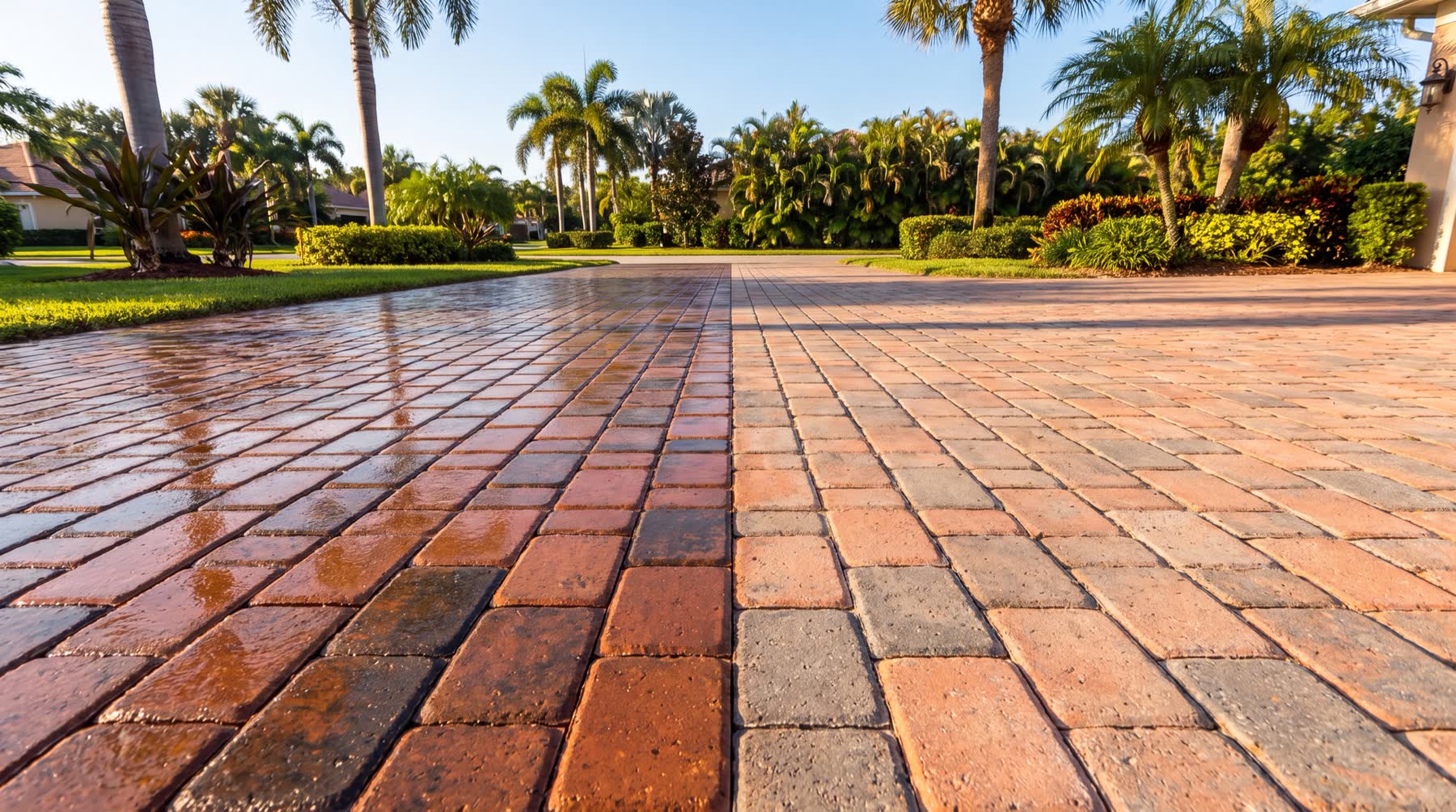
Fading is the first tell. Wet-look sealer loses its sheen and starts looking dull or chalky, and colors that were rich when it went down start reading flat and gray. That's the sealer thinning out, not the pavers themselves changing color.
Joint sand washing out is a bigger signal. If you notice sand missing from between pavers, or joints that used to be tight are now open and gap-toothed, water and traffic have been working past a sealer layer that isn't locking the sand in the way it used to.
Black spotting is the one to act on. Dark spots or streaks, especially in shaded or damp corners, usually mean mold, mildew, or algae have found a foothold because the sealer's protective layer has worn thin enough to let moisture sit in the surface instead of shedding off it.
Why clean and dry, always, before resealing
Sealer needs to bond to the paver surface, not to whatever's sitting on top of it. Dirt, pollen, algae film, or old sealer residue between the coat and the paver means the new sealer bonds to debris instead of stone or concrete, and it lifts or peels in patches instead of holding evenly.
Dry matters just as much as clean, and it's the part people underestimate in Florida. If there's moisture in the paver or in the joint sand when sealer goes down, that moisture gets trapped underneath the new coat. It has nowhere to go, and it shows up later as cloudiness, bubbling, or whitish blotches under the sealer.
That's why we don't seal on a schedule that ignores the weather. A surface that got rained on or hosed down needs real drying time first — humidity and recent rain change how long that takes, and rushing it is how a sealing job goes wrong even when the sealer itself is a good product.
Does where you live in Brevard change the timeline?
Yes, meaningfully. Surfaces right along the beachside and barrier island stretches take the fullest hit from salt air and direct sun — that combination tends to shorten the interval between resealing compared to homes further inland along the US-1 or I-95 corridor.
Older tree-lined streets with more shade can go the other way. Less direct UV exposure slows down the fading and breakdown, though shade brings its own tradeoff — more moisture sitting on the surface longer after rain, which is exactly what feeds the black spotting we mentioned above.
Either way, the fix is the same: look at the actual surface condition instead of assuming a fixed calendar date. We measure and look at the wear pattern on-site rather than guessing off location alone.
Free estimate
Rather just ask us?
Two minutes on the phone usually settles it — or send a photo of the space.
Related questions
What people ask next.
Can I reseal over old sealer without stripping it first?
It depends on condition. If the old coat is worn but intact and the surface is clean and dry, a fresh coat can usually go over it. If it's flaking, peeling, or heavily discolored, that old layer needs to come off first — resealing over failing sealer just traps the problem under a new coat.
Does sealing pavers make them slippery?
It can, depending on the finish and the surface. Wet-look sealers add more sheen and can read more slippery when wet, especially around pools. Matte finishes and sealers with traction additives hold grip better in those spots — we match the finish to where the surface sits.
Do I need to reseal turf or artificial grass the same way?
No — turf isn't paver sealer's territory. Turf maintenance is about rinsing, brushing the fibers back upright, and keeping the base draining well, not a sealer coat. Pavers and turf are different systems with different upkeep, even when they're installed right next to each other in the same yard.
Can I just pressure wash instead of resealing?
Pressure washing helps between sealing cycles — it clears surface dirt and organic growth — but it doesn't restore the protective coat that's worn away. Once sealer has thinned to the point of fading or letting sand wash out, washing alone won't stop that; the surface needs an actual reseal.
Keep reading
Where to go from here.
Fastest answer
Instant quote — give us a call.
Most questions we can answer on the phone in two minutes, and if we need to see it we'll book the walkthrough while you're on the line.
(321) 586-9227Or text a photo of the space — that's often the fastest way to get a real answer. Prefer email? info@groundworkspaversandturf.com.
Free estimate
Get a written number instead.
Free walkthrough, itemized estimate, no pressure.
Five quick questions — then you're booked in and someone reaches out within 5 minutes. Prefer to talk? Call (321) 586-9227.