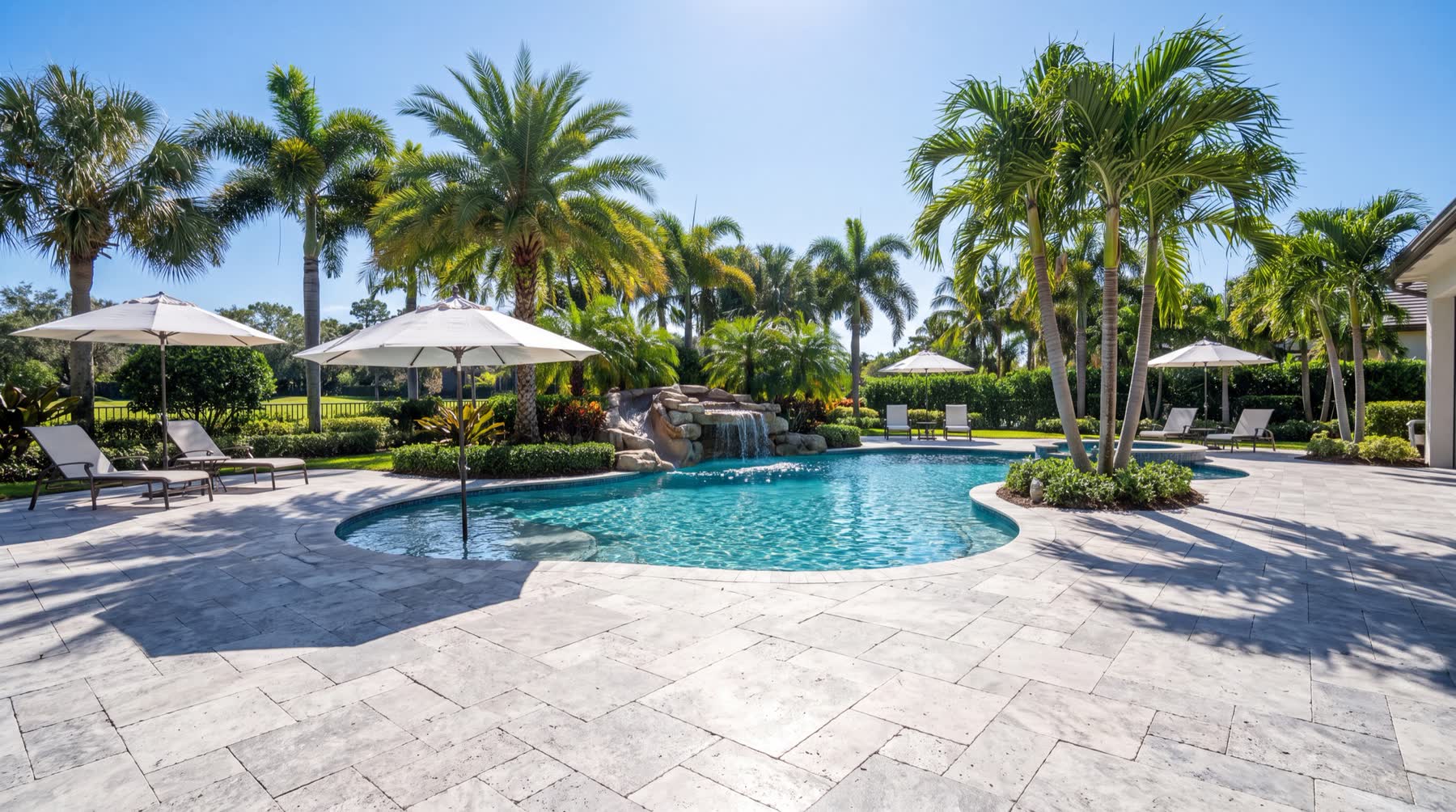
Concrete pavers and travertine around Brevard County pools — picked for bare feet, textured for the waterline, pitched to send water away from the shell. Call Owen at (321) 586-9227 for a free written itemized estimate.
Brevard County localMelbourne to Titusville — we work where we live
Built to spec, not to priceBase and edge detail done right the first time
Free written estimatesItemized, so you can compare it honestly
Stone. Seal. Green.Four services, one company, one standard
How we build it
BAREFOOT IN AUGUST, done right.
A pool deck has one job the rest of your hardscape doesn't: you walk on it barefoot, wet, in August. That changes how we think about every choice on the project. Color matters, because the Florida sun bakes heat into dark surfaces the same way it bakes color out of pavers. Texture matters more in the three feet around the waterline than anywhere else on the deck — that's where wet feet push off. Across Brevard County — Melbourne, Viera, Merritt Island, Palm Bay, the beachside from Satellite Beach down to Melbourne Beach — we build pool decks around two questions first: can you stand on it at noon, and can you trust it wet.
The part you don't see matters just as much. A pool deck has to shed water away from the pool shell, not toward it, so we set the pitch before the first paver goes down and build the base in compacted lifts so it doesn't settle into a low spot later. Edge restraint gets anchored into that base, not into sand. If you run a salt system, splash-out leaves salt on the deck every swim day, which is one more reason sealing done right matters here: sealer goes on clean, completely dry pavers or it clouds, so we time that work around rain and pool use, not around our schedule. Wet-look or matte — your call.
What that means on your job
The details that decide how it ages.
The Barefoot Test
Dark pavers in full Florida sun get hot enough to change how you use your own pool. We talk color early, and we'll tell you straight when a tone you love is going to cook in July. Travertine tends to run cooler underfoot than most concrete pavers, which is why it earns its place around so many pools.
Grip at the Waterline
The three feet around the coping is where wet feet meet the deck. We look at surface texture there before pattern or color, and when it's time to seal we walk you through wet-look versus matte — a glossier finish looks sharp, but the finish choice should follow how the deck actually gets used.
Pitched Away From the Shell
Splash-out and rain have to drain away from the pool shell, not back toward it. We set that pitch first, build the base in compacted lifts, and anchor the edge restraint into the base instead of the sand — because a deck that settles sends water exactly where you don't want it.
Free estimate
Start with someone walking your yard.
We'll measure, look at where the water goes, and leave you an itemized written estimate — anywhere in Brevard County. No charge, no pressure.
They can. A dark paver in full Florida sun will be hot by mid-afternoon, and no sealer changes that. Color is the main lever — lighter tones stay noticeably cooler in the same sun. It's the first thing we bring up when we look at a pool deck, because a surface you can't cross barefoot in July changes how you use your own pool.
Travertine or concrete pavers for a pool deck?
Both make a good deck when the base under them is right. Travertine tends to run cooler underfoot and brings a natural texture that works well wet, which is why it comes up around pools so often. Concrete pavers give you more sizes, colors, and patterns to work with. We install and seal both, and the prep underneath — compacted base, pitch away from the shell — is the same conversation either way.
Can you seal a pool deck someone else installed?
Yes. We seal pavers other companies installed, and that includes pool decks. The rule doesn't change: sealer has to go on clean and completely dry pavers or it clouds, and a pool deck takes more planning to get dry than a driveway does — splash-out counts as rain. We'll also re-sand the joints with polymeric sand where they've washed thin. Wet-look or matte, your choice.
How often does a pool deck need resealing?
Roughly every 2-3 years is the honest guidance. A pool deck works harder than a walkway — constant splash, full sun, and if you run a salt system, salt landing on the surface every swim day. The Florida sun bakes color out of pavers, and sealer is what slows that down. Call (321) 586-9227 and we'll look at yours and put it in a free written itemized estimate.
Fastest answer
Instant quote — give us a call.
Most questions we can answer on the phone in two minutes, and if we need to see it we'll book the walkthrough while you're on the line.