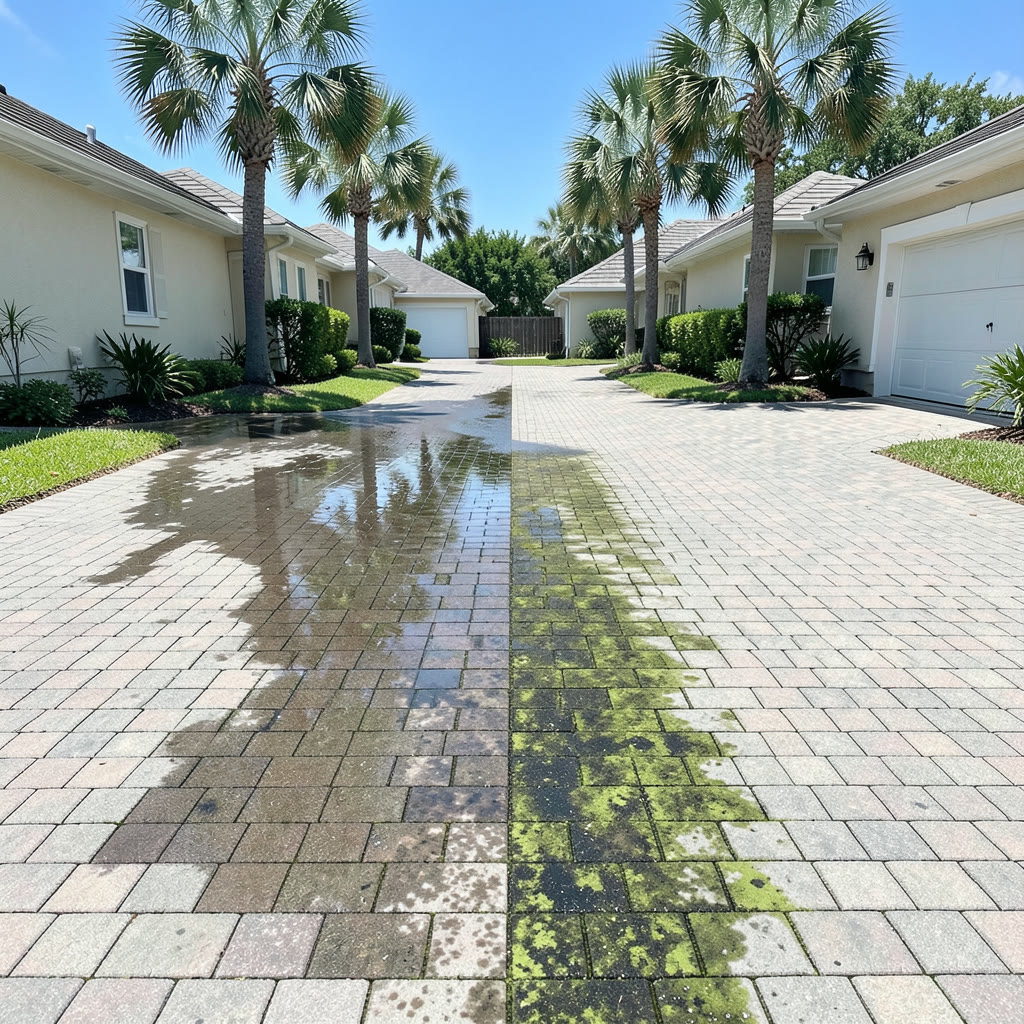
PRESSURE WASHING DONE THE RIGHT WAY, IN THE RIGHT ORDER
Algae on the shady side, rust rings from the sprinklers, salt film if you're near the water — every property in Brevard picks something up. We match the method to the surface, and on pavers, we don't call it done until the joints are sanded and sealed.
Brevard County localMelbourne to Titusville. We work where we live.
Built to spec, not to priceBase and edge detail done right the first time
Free written estimatesItemized, so you can compare it honestly
Stone. Seal. Green.Four services, one company, one standard
Recent work
Cleaned & sealed recently.
Drag or swipe to browse · tap a photo to open it
On the job
Washing, on camera.
Real footage from Groundworks pressure washing jobs. Clips play as you scroll.
Pressure washing a condo paver lotPressure washing pavers at a condo entrancePressure washing a covered paver entryPressure washing a screened pool deck
What we wash
Washing that respects the surface.
We wash concrete driveways and walkways, paver patios and pool decks, pool cage screens, and house exteriors — siding, soffits, and rooflines. Brevard puts everything to the test: green algae and mildew take over anything shaded, well-water irrigation leaves orange rust rings on concrete and pavers, and salt film builds up the closer you get to the water. We start by looking at what the surface is made of and what's actually growing on it, then pick the method that fits — flatwork and house exteriors don't get treated the same way.
Pressure and soft-wash aren't interchangeable — they're for different surfaces. Concrete and pavers can take direct pressure, so that's where it belongs. Siding, soffits, and rooflines can't; a soft-wash uses low pressure and a cleaning solution that kills algae and mildew without stripping paint or forcing water behind the panels. Pavers have a wrinkle: pressure that lifts grime off pavers also blasts the sand out of the joints, and that sand is what locks the pavers together. A paver wash that skips re-sanding — and ideally sealing — is only half finished.
The work
Three kinds of washing.
Driveways & Concrete
Full pressure on driveways, walkways, and patios — enough to strip algae, dirt, and the orange rust rings well-water sprinklers leave behind. We check the concrete before we start so we're not driving water into cracks or joints that are already open.
House Soft-Wash
Siding, soffits, and rooflines get a soft-wash — low pressure and a cleaning solution, not a hose blasting inches from the surface. It kills the algae and black mold at the root instead of just knocking the surface film off, and it won't force water behind your siding.
Pavers: Wash, Re-Sand & Seal
Washing pavers pulls sand out of the joints along with the grime. We treat that as one job, not three separate calls — wash, re-sand every joint, and seal if you want the color and the clean to actually hold.
Free estimate
Send us a photo of the grime.
Text a picture and we'll tell you whether it's a wash, a wash-and-seal, or not worth paying for yet.
Do you pressure wash everything, or is it different for the house?
Different for the house. Concrete and pavers can take direct pressure. Siding, soffits, and rooflines get a soft-wash instead — low pressure plus a cleaning solution — because full pressure can strip paint or push water where it shouldn't go.
What's causing the orange stains on my driveway or pavers?
Most of the time it's well-water irrigation. Brevard well water carries iron, and every pass of the sprinklers over the same stretch of concrete or pavers leaves a rust ring behind. It's common enough that it's one of the first things we check for on a walkthrough.
If you wash my pavers, do you automatically re-sand them?
We recommend it, because washing pulls sand out of the joints whether we mean to or not. Pavers with empty joints move around more and weeds have an easier time getting in. We'll show you the joints after the wash and talk through re-sanding and sealing before we call the job done.
How often should a driveway be pressure washed in Florida?
When it starts to show, and in Brevard that comes down mostly to shade and sprinklers. A driveway in open sun can often go a year or more between washes. A walkway on the north side of the house, or a slab under trees, can turn green much sooner. Wash it when you see a green or black film, when it gets slick after rain, or when orange rings show up near the sprinkler heads. Sealed pavers hold a clean look longer.
Can pressure washing damage pavers or concrete?
It can, if the pressure is too high or the tip is held too close. On concrete that shows up as wand marks, streaks etched into the surface that won't wash out. On pavers it wears the face and blasts out the joint sand. Old, worn surfaces are the most at risk, and so is concrete with cracks already open. We look at the condition first and set the pressure, tip and distance for that surface.
Is pressure washing the same thing as power washing?
Mostly, yes. Most people and most companies use the two names for the same job. When someone does draw a line, power washing usually means the machine heats the water, which helps with grease and oil. What matters more on your property is whether the pressure and the cleaning solution fit the surface, because concrete, pavers and painted siding each need different handling.
Why does the green come back so fast after some pressure washes?
Because pressure alone knocks algae and mildew off the top without killing it, and it grows back from what's left in the surface. We treat the growth with a cleaning solution that kills it, then wash. It still returns eventually, since shade and Florida humidity keep feeding it. Anything that helps the surface dry faster slows it down, like trimming back low branches or keeping sprinkler spray off the concrete.