
The short answer
What wet-look sealer actually is
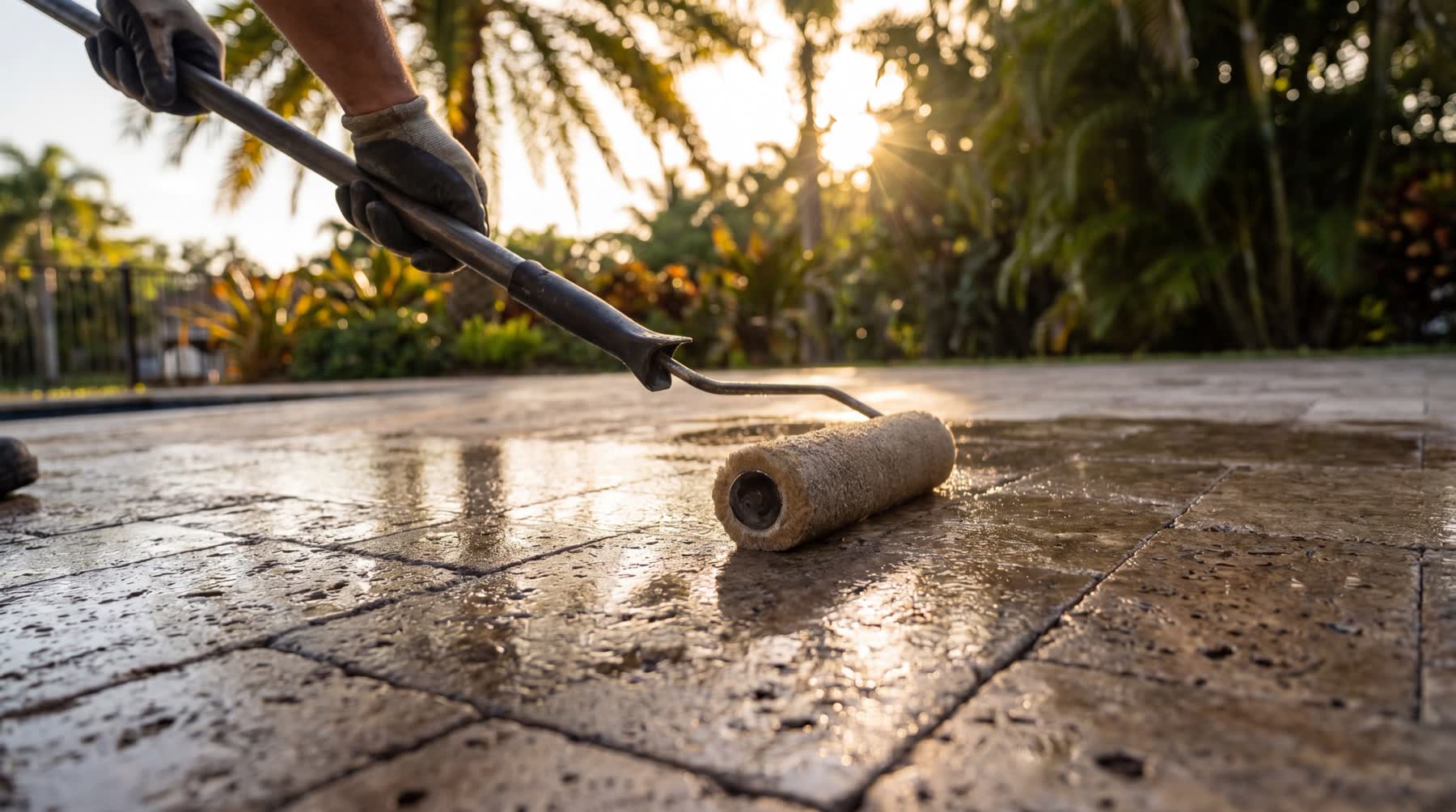
Wet-look sealer is a topical coating that sits on the paver surface and leaves a glossy, saturated finish — it's the look of pavers right after a rain, held in place instead of drying back out. It deepens color and adds shine, which is why it's the finish most people picture when they think "sealed pavers."
That gloss comes from a film-forming sealer sitting on top of the stone or concrete rather than soaking fully into it. The film is what gives the shine, and it's also the part that takes the UV and foot-traffic wear over time — which is exactly why resealing on a normal cycle matters more with a glossy finish, since the wear shows visually as the shine fades.
Wet-look reads best on richer paver colors and on surfaces people look at more than they walk hard on — a front walkway, a patio border, an entry feature. The shine draws the eye, so it earns its keep where the surface is meant to be seen.
What matte finish preserves instead
Matte (sometimes called a "natural look") sealer protects the same way underneath but doesn't leave the glossy film on top — the pavers keep close to their dry, as-installed appearance instead of taking on a shine. If you don't want your driveway to look visibly "coated," matte is the finish that does that.
Because there's less of a film sitting on the surface, matte sealers tend to show wear less obviously over time — there's no shine to fade, so the surface ages more gradually to the eye even as it's going through the same UV and salt-air exposure as a glossy coat.
Matte suits pavers where you want protection without changing the character of the material — natural stone especially, where a lot of the appeal is texture and variation that a heavy gloss can flatten out visually.
Breathability — the part that actually matters underneath
Whatever finish you pick, the sealer still needs to let moisture that gets into the paver or the base escape rather than trapping it. A sealer applied over a wet or damp surface, or applied too thick, can seal moisture in underneath the coating instead of on top of it.
Trapped moisture is what causes cloudy, whitish patches or bubbling under a sealed surface — it's a common failure and it's avoidable. It's not usually about wet-look versus matte as products; it's about surface prep and application, which is why clean-and-dry before sealing isn't a nice-to-have step, it's the step that determines whether the job holds.
This is also why we don't seal right after a rain, or right after pressure washing, no matter which finish a customer wants. The base and the paver body need real time to dry out first — how long depends on humidity and sun exposure that day — or the finish choice won't matter because the underlying problem shows up under either one.
Slip considerations, especially around a pool
Wet-look sealers, by nature of the glossy film, can read more slippery when the surface is actually wet — which matters most right where water is guaranteed to be sitting, like a pool deck or a covered lanai that gets splashed.
Matte finishes generally hold better grip underfoot in those same wet conditions, since there's less of a slick film sitting on top. Some sealers are also formulated with texture additives specifically for pool decks and walkways, which add grip without changing the finish family.
The safest approach on a pool deck is to talk through the finish before sealing, not after — matching the sealer to how the surface actually gets used, barefoot and wet most of the time, matters more there than it does on a driveway that's dry most days.
Which surfaces suit which finish
Driveways and entry walkways lean toward wet-look more often — they're seen daily, the color-deepening effect shows off the paver pattern, and the traffic is mostly tires rather than bare feet, so slip risk is a smaller factor.
Pool decks and lanais lean toward matte for the grip reasons above, especially wherever bare feet and standing water are a given. Natural stone patios often go matte too, simply to keep the material looking like itself rather than adding heavy shine.
There's no wrong answer built into the paver — it's a judgment call based on how the space gets used and what look the homeowner wants. We walk through both finishes on-site so you're picking based on how your surface actually looks and feels in real light, not a sample chip.
Free estimate
Rather just ask us?
Two minutes on the phone usually settles it — or send a photo of the space.
Related questions
What people ask next.
Can I switch from wet-look to matte (or the other way) when I reseal?
Generally yes, as long as the old sealer is fully stripped first — you can't layer a matte finish over a glossy film and expect it to look matte, or vice versa. Switching finishes is a bigger job than a routine reseal, so it's worth deciding upfront rather than mid-project.
Does wet-look sealer make pavers darker permanently?
The color deepening only lasts as long as the sealer film does — it's the gloss enhancing the paver's existing color, not dyeing it. As the sealer wears and gets reapplied, the surface goes back to whatever look the fresh coat gives it, so it's not a permanent change to the paver itself.
Is one finish more expensive to maintain than the other?
Both finishes need the same basic rhythm — occasional cleaning and resealing on a normal cycle — since the underlying protection works the same way. The real cost driver is exposure to sun, salt air, and traffic, not which finish you picked, so neither one is inherently higher-maintenance than the other.
Can I mix finishes — wet-look on the driveway, matte on the pool deck?
Yes, that's a common and reasonable split. There's no requirement that every paver surface on a property match, and picking the finish per area based on how it's used — driveway versus pool deck versus patio — is usually the more practical call anyway.
Keep reading
Where to go from here.
Fastest answer
Instant quote — give us a call.
Most questions we can answer on the phone in two minutes, and if we need to see it we'll book the walkthrough while you're on the line.
(321) 586-9227Or text a photo of the space — that's often the fastest way to get a real answer. Prefer email? info@groundworkspaversandturf.com.
Free estimate
Get a written number instead.
Free walkthrough, itemized estimate, no pressure.
Five quick questions — then you're booked in and someone reaches out within 5 minutes. Prefer to talk? Call (321) 586-9227.