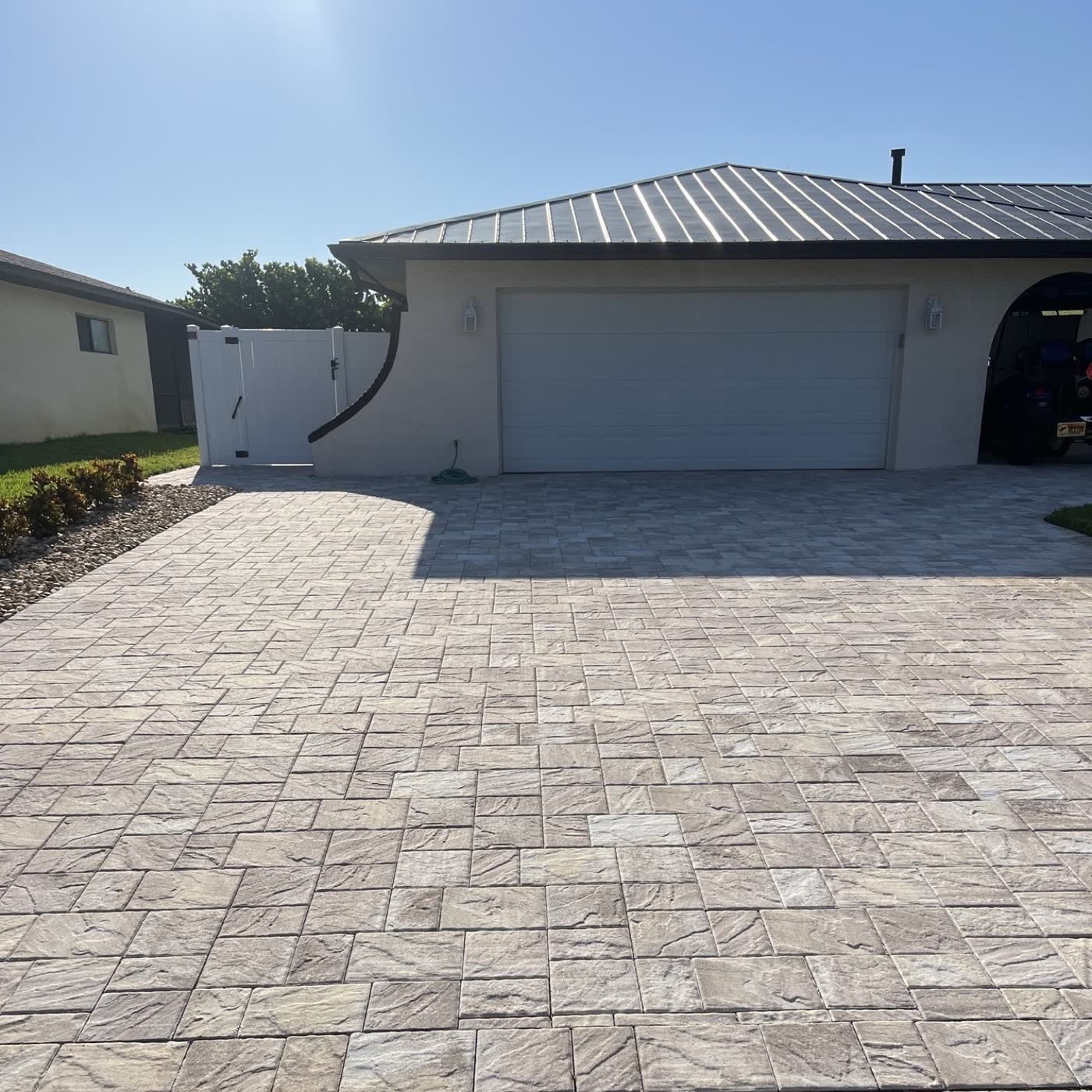
Melbourne mixes decades-old patios with brand new builds — we install pavers with a compacted base and edge restraint fastened in, whichever kind of lot you've got.
Melbourne mixes decades-old surfaces with brand-new builds, and it shows in the driveways — older tree-lined streets near the river sitting next to newer construction going up around them. A lot of what's already down was laid the fast way: shallow base, no real compaction, edge restraint that's more decorative than structural. When we install pavers in Melbourne, whether it's a first driveway on new construction or a full replacement job, we start with a compacted base in lifts, not a shortcut.
Older Melbourne lots near the river tend to have mature trees, which means roots working under a patio or walkway over time, and drainage that doesn't always run where you'd guess. We grade for water first, then build a compacted base in lifts thick enough to handle root pressure, with about an inch of bedding sand on top, never more. Edge restraint gets fastened into the base, not floated in the sand, and driveways go down herringbone so wheel traffic doesn't work the joints loose.
What that looks like here
Melbourne work, specifically.
Built For What's Already There
Melbourne lots run from older tree-lined streets to brand new construction. We check what's under the ground before planning the base — root systems, old fill, existing drainage — so the new work outlasts the shortcuts nearby.
Herringbone Where It Counts
Driveways get laid in a herringbone pattern because it locks under tire load better than a running bond. A patio doesn't see that stress, so we match the pattern to the job, not just the look.
Water Gets Planned First
Before any base goes down, we look at where the water goes — toward the house, toward the street, or nowhere at all on some of these older lots. Grade gets fixed before pavers, not after.
By the numbers
Melbourne homes, by the numbers.
The Brevard County tax roll counts 30,009 single-family homes in Melbourne, not counting ZIP 32940 (Viera and Suntree). The typical one was built in 1984, and about 79% were built before 2000.
With most homes here past twenty-five years old, many cracked or worn driveways and patios are ready to be replaced with pavers.
Source: Florida Department of Revenue, Brevard County 2026 preliminary tax roll.
Free estimate
Start with someone walking your yard.
We'll measure, look at where the water goes, and leave you an itemized written estimate — anywhere in Melbourne. No charge, no pressure.
My driveway already has a low spot where water sits — can you fix that during a repave?
Yes — that's a grading problem, not a paver problem, and it usually traces back to how the original base was built. We'll regrade before laying the new base, so the water actually moves instead of pooling in the same spot again.
I've got big oak trees near my patio — will roots be a problem?
Roots are common on older Melbourne lots, especially near the river. We check for them before we dig, build the base thick enough to handle some root pressure, and route around anything major instead of cutting through it.
Can you match new pavers to a section that's already there, or does it all have to be torn out?
Depends on the section — sometimes we can extend a driveway or patio and match material closely enough it reads as one job. If the existing base is failing, patching new pavers on top of it just fails again, so we'll tell you straight if it needs a full tear-out.