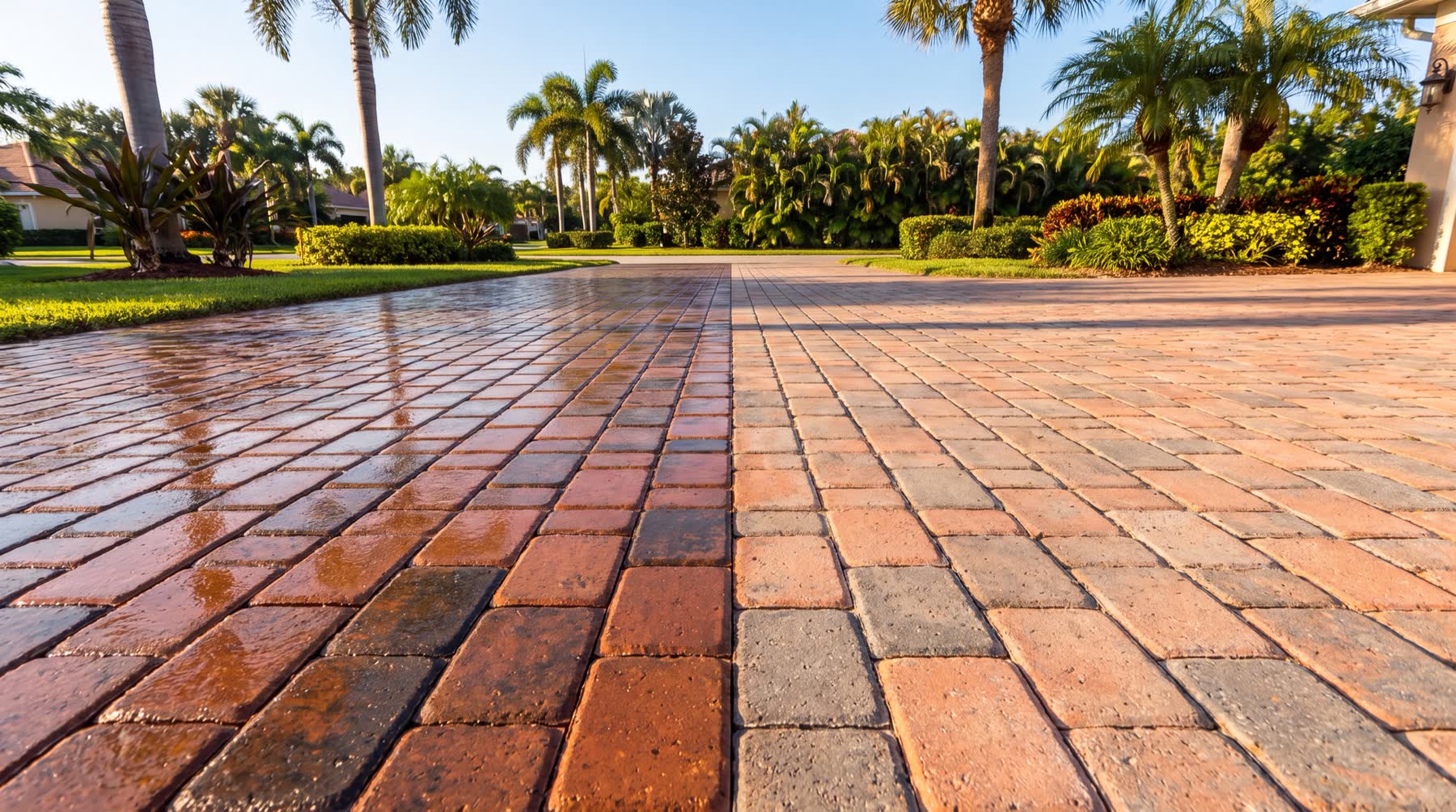
A lot of Melbourne's paver surfaces are older installs that have never been sealed — we clean them down, restore the color, and seal them so the next few years don't wear the same way.
Cleaning and sealing in Melbourne, without the shortcuts.
Melbourne has more existing paver surfaces than most of the county — driveways and patios put in years ago on those older tree-lined streets, plenty of them never sealed at all. Sun, tree sap, and general age leave the surface looking worn and the joints thin. Before we touch a Melbourne restoration job, we look at what's actually going on — worn sealer, sand loss, staining — instead of just spraying a coat over the top and hoping it holds.
Restoring an older Melbourne surface starts with getting it clean and completely dry — sealer over damp pavers traps moisture underneath and turns cloudy within days. We pressure wash to pull embedded grime, refill joints with fresh polymeric sand where it's thinned out, then apply a wet-look or matte sealer depending on the look you want. UV and salt air off the riverfront work on pavers year-round here, so re-sealing roughly every two to three years keeps the surface protected instead of going bare again.
What that looks like here
Melbourne work, specifically.
Clean And Dry, Not Just Sprayed
We pressure wash first and let the surface fully dry before any sealer goes down. Sealing over pavers that are still damp traps moisture underneath, and that's what causes the cloudy, patchy look people blame on the product.
Joint Sand Gets Refilled
Older Melbourne patios and driveways usually have joint sand that's washed or blown out over the years. We refill with polymeric sand before sealing, which locks the pavers together and keeps weeds from working up through the gaps.
Wet-Look Or Matte, Your Call
Some homeowners want that deep, wet-look shine; others want the pavers to still look like stone. Both are real sealer options — we'll show you a sample on your actual surface before you commit either way.
By the numbers
Melbourne homes, by the numbers.
The Brevard County tax roll counts 30,009 single-family homes in Melbourne, not counting ZIP 32940 (Viera and Suntree). The typical one was built in 1984, and about 79% were built before 2000.
With most homes here past twenty-five years old, a lot of the pavers and slabs have decades of sun and rain on them. That usually means cleaning and re-sanding before any sealer goes down.
Source: Florida Department of Revenue, Brevard County 2026 preliminary tax roll.
Free estimate
Start with someone walking your yard.
We'll measure, look at where the water goes, and leave you an itemized written estimate — anywhere in Melbourne. No charge, no pressure.
In Melbourne the thing that ruins a DIY seal is usually the afternoon storm nobody planned around. Sealer needs a genuine weather window — dry going down and dry while it cures — and a summer afternoon here can close that window with little warning. Rain on an uncured coat is not a cosmetic problem; it is the direct cause of the blotchy, cloudy finish that has to be stripped rather than recoated.
Summer heat is the second trap, and it is the one people miss. Western Interlock warns that a paver surface above 90°F during application, or within two hours after, causes bond failure — and surface temperature is not air temperature. A Melbourne driveway in full July sun passes 90°F at the surface long before the thermometer on the porch does. Irrigation is the quiet version of the same mistake: a sprinkler zone catching the edge of a driveway will re-wet a curing coat overnight on a timer nobody remembered to shut off.
Honest comparison
DIY versus hiring it out.
Where the two paths actually differ — and what happens when a coat goes wrong.
Doing it yourself
Groundworks
Surface prep
Rented washer, homeowner technique — the pressure that lifts old sealer is also the pressure that erodes paver faces and blows out joint sand.
Cleaning matched to the surface, plus the algae, rust and efflorescence treatment a rinse alone doesn’t touch.
Drying time
Judged by eye. The paver top dries hours before the joint sand underneath does.
Judged by condition and forecast — the step most often skipped, and the one most failures trace back to.
Temperature window
Air temperature off a phone app.
Surface temperature checked — above 90°F at the surface the bond fails, and surface runs far hotter than air.
Joint sand
Easy to seal before the sand is set, or to use a sand that isn’t right for the joint.
Re-sanded and set first — and after polymeric sand, manufacturers specify a 30-day wait before sealing.
Product choice
Whatever the store stocks — solvent and water-based, film-forming and penetrating, all sold side by side.
Chosen for the surface, its exposure, and the finish you actually want.
How much to buy
Estimated from the bucket’s headline coverage rate.
Calculated from the real rate — a penetrating sealer needing two mandatory coats covers roughly half what a single-coat figure suggests.
Application
Roller or pump sprayer, wet edge held by hand across the whole area.
Even coverage at a consistent rate, low-pressure spray, edges and adjacent surfaces masked.
If it goes wrong
Once cured, it has to be chemically stripped — dwell time, a second application if any re-adheres, vegetation soaked to protect it, then re-sanding — before anything can be re-applied.
Corrected by the crew that applied it.
On a small patio with a penetrating sealer and a real dry window, doing it yourself is a reasonable project — we say so plainly in our honest DIY comparison. If a coat has already gone cloudy or started peeling, start with fixing a seal that went wrong.
Local questions
Melbourne questions.
My patio pavers have never been sealed since the house was built — is it too late?
No. We clean the surface, deal with any staining or sand loss, and seal from there — an unsealed Melbourne patio just needs a more thorough cleaning pass first than one that's been maintained along the way.
How often do I actually need to reseal?
Roughly every two to three years, depending on sun exposure and how close you are to the riverfront — salt air and UV both break sealer down faster than people expect. We'll give you a realistic number for your specific yard, not a blanket answer.
Can you seal over the old sealer or does it have to come off first?
Depends on the condition. If the old coat is worn evenly, we can often clean and reseal right over it. If it's peeling or blotchy, that has to come off first, or the new sealer just locks the same problem in underneath.