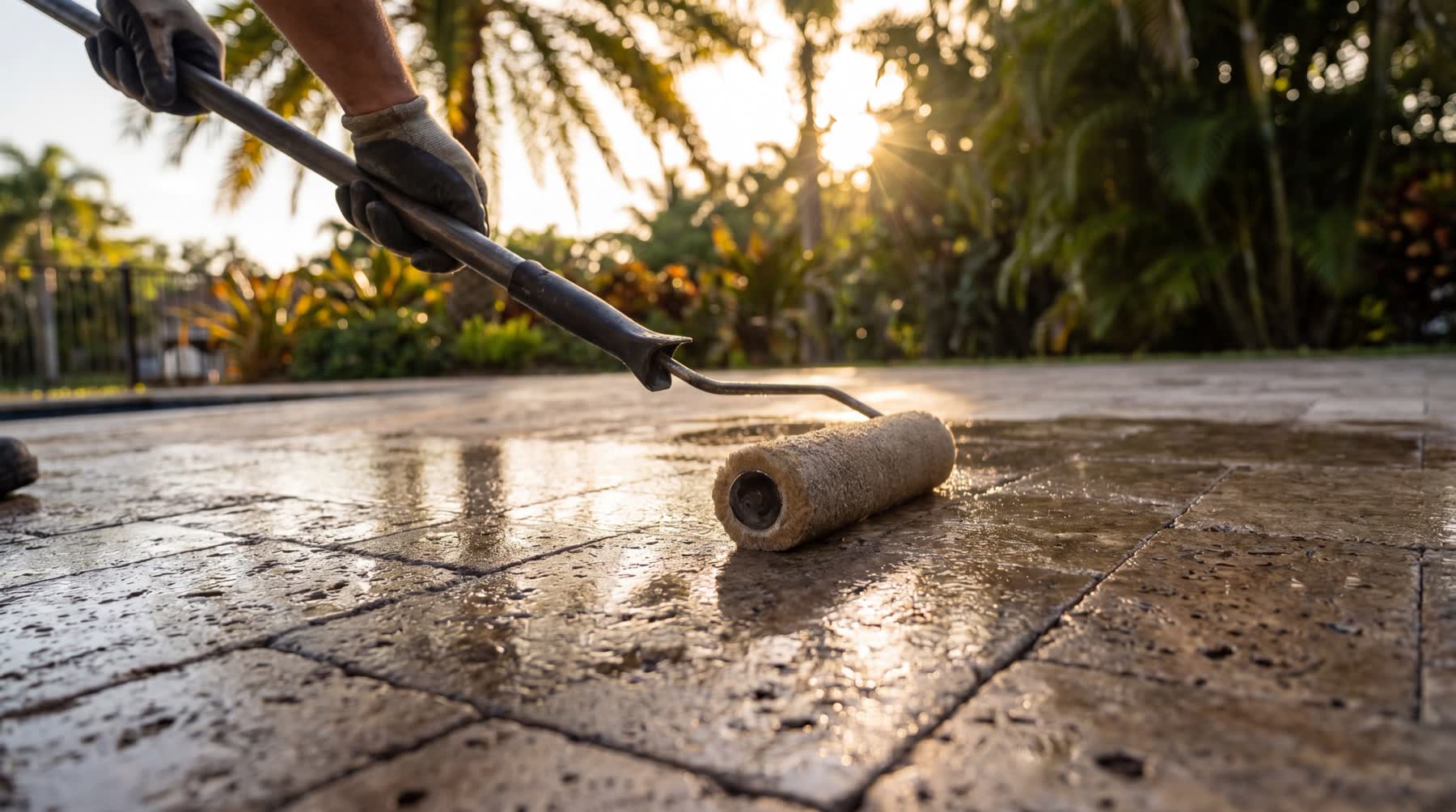
If you just put in pavers in West Melbourne, sealing keeps that new look instead of watching it wear the way builder-grade surfaces do — and if you inherited an older install with the house, we'll get it caught up.
Cleaning and sealing in West Melbourne, without the shortcuts.
West Melbourne skews newer, so a lot of the sealing calls here are on pavers installed within the last few years — a driveway or pool patio put in with the house, or shortly after, now due for its first protective coat. Families in these newer subdivisions use their outdoor space hard: pool decks, grills, kids running from wet grass onto the patio. Sealing isn't cosmetic here so much as it's protecting a fairly fresh investment from the stuff that actually causes trouble — sunscreen, chlorine splash, grease.
The surface has to be clean and completely dry before sealer goes down — pavers that look dry on top can still be damp underneath in Florida humidity, and sealing over that traps moisture and clouds the finish. We wash the surface, address any early staining before it sets, and apply a wet-look or matte sealer, pool deck versus front driveway. UV and salt air work on pavers year-round, so a newer West Melbourne install lands on the same two-to-three-year reseal clock as an older one.
What that looks like here
West Melbourne work, specifically.
Catch It Before It Stains
Newer patios around West Melbourne pools take a beating from sunscreen, chlorine, and grease drips before anyone thinks about sealing. Getting a coat down early keeps that from soaking into unsealed pavers in the first place.
Matched To Pool Or Driveway
A pool deck usually wants a different finish than a front driveway — less glare, sometimes a different texture underfoot. We'll walk you through wet-look versus matte on the actual surface before you decide.
Dry Means Dry, Not Just Dry-Looking
Florida humidity keeps pavers holding moisture longer than they look like they are. We confirm the surface is dry all the way through before sealing, because trapped moisture under a fresh coat is what causes clouding.
By the numbers
West Melbourne homes, by the numbers.
The Brevard County tax roll counts 8,257 single-family homes in West Melbourne. The typical one was built in 2004, and about 30% were built before 2000.
Source: Florida Department of Revenue, Brevard County 2026 preliminary tax roll.
Free estimate
Start with someone walking your yard.
We'll measure, look at where the water goes, and leave you an itemized written estimate — anywhere in West Melbourne. No charge, no pressure.
In West Melbourne the thing that ruins a DIY seal is usually the afternoon storm nobody planned around. Sealer needs a genuine weather window — dry going down and dry while it cures — and a summer afternoon here can close that window with little warning. Rain on an uncured coat is not a cosmetic problem; it is the direct cause of the blotchy, cloudy finish that has to be stripped rather than recoated.
Summer heat is the second trap, and it is the one people miss. Western Interlock warns that a paver surface above 90°F during application, or within two hours after, causes bond failure — and surface temperature is not air temperature. A West Melbourne driveway in full July sun passes 90°F at the surface long before the thermometer on the porch does. Irrigation is the quiet version of the same mistake: a sprinkler zone catching the edge of a driveway will re-wet a curing coat overnight on a timer nobody remembered to shut off.
Honest comparison
DIY versus hiring it out.
Where the two paths actually differ — and what happens when a coat goes wrong.
Doing it yourself
Groundworks
Surface prep
Rented washer, homeowner technique — the pressure that lifts old sealer is also the pressure that erodes paver faces and blows out joint sand.
Cleaning matched to the surface, plus the algae, rust and efflorescence treatment a rinse alone doesn’t touch.
Drying time
Judged by eye. The paver top dries hours before the joint sand underneath does.
Judged by condition and forecast — the step most often skipped, and the one most failures trace back to.
Temperature window
Air temperature off a phone app.
Surface temperature checked — above 90°F at the surface the bond fails, and surface runs far hotter than air.
Joint sand
Easy to seal before the sand is set, or to use a sand that isn’t right for the joint.
Re-sanded and set first — and after polymeric sand, manufacturers specify a 30-day wait before sealing.
Product choice
Whatever the store stocks — solvent and water-based, film-forming and penetrating, all sold side by side.
Chosen for the surface, its exposure, and the finish you actually want.
How much to buy
Estimated from the bucket’s headline coverage rate.
Calculated from the real rate — a penetrating sealer needing two mandatory coats covers roughly half what a single-coat figure suggests.
Application
Roller or pump sprayer, wet edge held by hand across the whole area.
Even coverage at a consistent rate, low-pressure spray, edges and adjacent surfaces masked.
If it goes wrong
Once cured, it has to be chemically stripped — dwell time, a second application if any re-adheres, vegetation soaked to protect it, then re-sanding — before anything can be re-applied.
Corrected by the crew that applied it.
On a small patio with a penetrating sealer and a real dry window, doing it yourself is a reasonable project — we say so plainly in our honest DIY comparison. If a coat has already gone cloudy or started peeling, start with fixing a seal that went wrong.
Local questions
West Melbourne questions.
My house is only two years old — do the pavers really need sealing already?
If they were never sealed at install, yes — unsealed pavers in West Melbourne start absorbing stains and losing joint sand from day one, newer build or not. Getting ahead of it now is easier than fixing staining that's already set in.
Will sealing make the pool deck slippery?
We can apply a textured or matte finish specifically for pool decks so it isn't glassy when wet. A high-gloss wet-look sealer makes more sense for a driveway than for anything you'll walk on barefoot out of the pool.
How soon after a new paver install should we seal?
There's a minimum cure time before sealing new pavers in West Melbourne — sealing too early can trap efflorescence and moisture underneath the coat. We'll walk your specific install and give you the right window instead of a generic timeline that ignores your base and the weather.