
The short answer
The short answer: there is no universal number
If you have searched this question and got four different answers, that is because there genuinely are four different answers. The major manufacturers do not agree, and the range between them is enormous — from about a week to as much as a year.
Belgard distinguishes by product type: roughly a week for a non-film-forming sealer, and about 30 days for a film-forming one, specifically to avoid trapping moisture. Nicolock is far more conservative, advising six to twelve months to let the surface and joint sand fully settle and stabilise. Other widely-cited guidance lands in between, around 60 to 90 days, on the reasoning that surface salts need time to work their way out.
Separately from all of that, Techniseal’s instructions specify about 30 days after polymeric sand is installed before sealing over it — a different clock, measuring a different thing.
So the honest answer is: follow the spec from your paver manufacturer, respect the polymeric sand wait as its own separate requirement, and understand what each waiting period is actually for. Anyone who gives you a single confident number without asking what your pavers are or what sand went in the joints is guessing.
What the waiting period is actually for
Efflorescence is the main reason. New concrete pavers release mineral salts as they cure, and those salts migrate to the surface as a white haze. It typically resolves on its own over the first months. Sealing before it has finished means locking that haze under the coat, where it cannot be removed without stripping the sealer.
Settling is the second reason, and it is Nicolock’s argument for the longest wait. A new installation moves slightly as it beds in and as joint sand consolidates. Sealing a surface that has not settled means stabilising joints that are about to shift.
Moisture is the third, and it is why film-forming products get the longer wait in Belgard’s guidance. A film seals the surface; anything still working its way out from underneath is then trapped.
Why the film-forming vs penetrating distinction matters most
This single distinction explains most of the disagreement. A penetrating sealer soaks into the paver rather than forming a surface layer, so moisture and salts can still move through — which is why Techniseal states its penetrating product will not trap efflorescence, and why Belgard’s shorter wait applies to non-film-forming products.
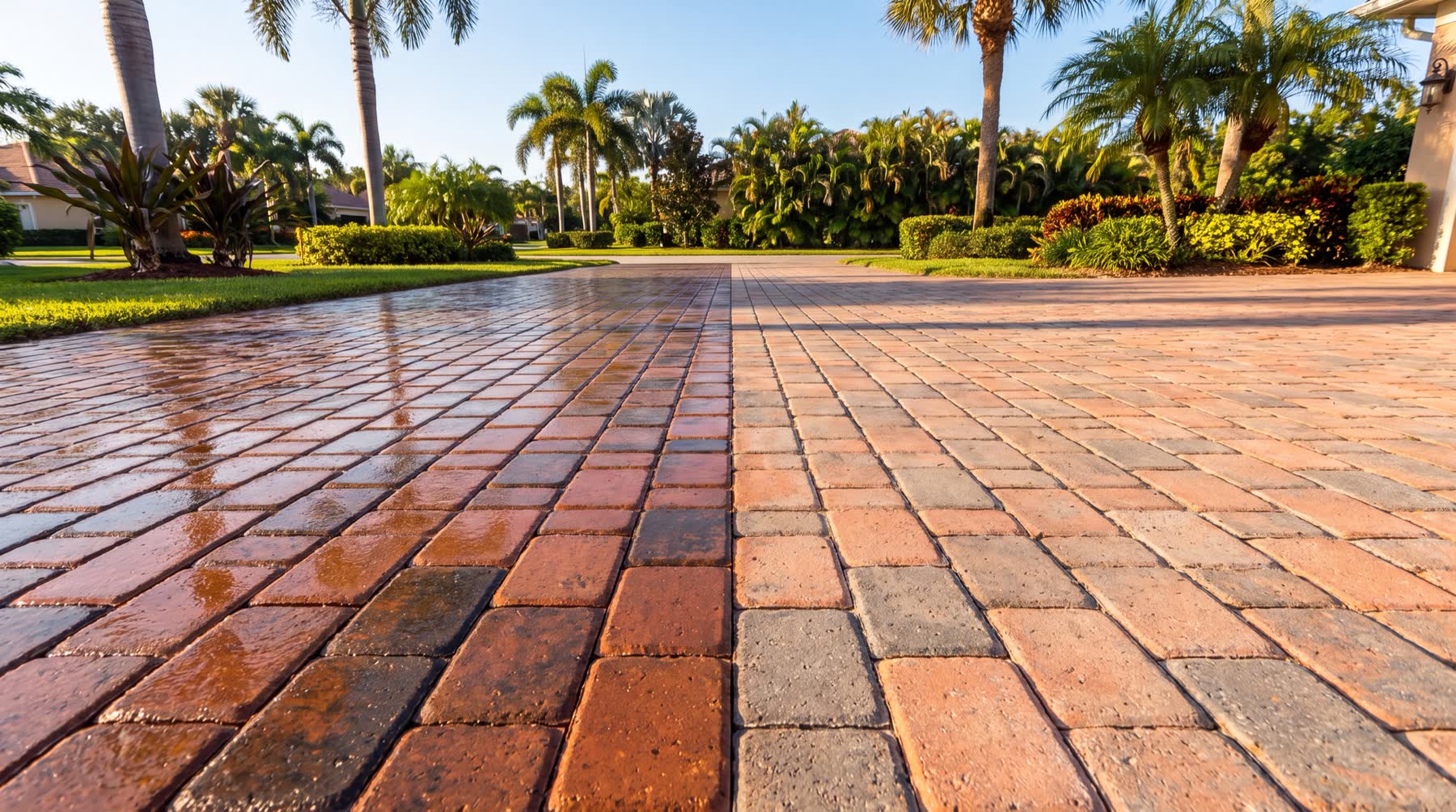
A film-forming sealer, including the wet-look finishes people usually want, creates a surface layer that everything underneath now has to get through. Techniseal acknowledges plainly that, like any film-forming coating, its wet-look product carries a small risk of trapping efflorescence beneath the film.
That is not an argument against wet-look sealers — they are what most people are picturing when they imagine sealed pavers. It is an argument for giving them the longer wait, and for being certain the surface has finished doing what new pavers do.
How to tell your surface is ready
Look for efflorescence and see whether it is still appearing. A white powdery bloom that returns after washing means salts are still working out. When washing removes it and it stops coming back, that process has largely run its course.
Check the joints. Sand that has consolidated and stays put is a settled installation; joints still losing sand are still moving.
Then apply the same conditions any sealing job needs: the surface genuinely dry all the way through including the joint sand, temperatures in the range the product specifies, no rain forecast for the day after, and the irrigation off.
And do a test patch. Techniseal makes a small test area a condition of its warranty — a few square feet, left to cure, tells you how this product behaves on this surface before you commit the whole driveway to it.
Free estimate
Rather just ask us?
Two minutes on the phone usually settles it — or send a photo of the space.
Related questions
What people ask next.
How long should I wait to seal new pavers?
It depends on your manufacturer and the sealer type. Belgard advises roughly a week for non-film-forming sealers and about 30 days for film-forming ones; Nicolock advises six to twelve months for settling; other guidance suggests 60 to 90 days for salts to release. Follow your paver manufacturer’s spec rather than a general rule.
How long after polymeric sand can I seal?
About 30 days, per manufacturer instructions. That is a separate requirement from any waiting period for the pavers themselves — it exists because moisture from the sand installation needs to leave before a sealer traps it, which is a common cause of haze under a new coat.
What happens if I seal new pavers too early?
The main risk is sealing in efflorescence — the white mineral haze new concrete pavers release as they cure — along with any moisture still leaving the surface. Once it is under a cured film it cannot be washed off; the sealer has to be stripped before the surface can be corrected.
Can I seal sooner with a penetrating sealer?
Generally yes, and that is why guidance differs by product type. Penetrating sealers do not form a surface film, so moisture and salts can still move through — manufacturers state a penetrating product will not trap efflorescence, and the shorter waiting periods apply to non-film-forming products.
Keep reading
Where to go from here.
Fastest answer
Instant quote — give us a call.
Most questions we can answer on the phone in two minutes, and if we need to see it we'll book the walkthrough while you're on the line.
(321) 586-9227Or text a photo of the space — that's often the fastest way to get a real answer. Prefer email? info@groundworkspaversandturf.com.
Free estimate
Get a written number instead.
Free walkthrough, itemized estimate, no pressure.
Five quick questions — then you're booked in and someone reaches out within 5 minutes. Prefer to talk? Call (321) 586-9227.