
The short answer
Why does site access change the price before a single paver goes down?
Every job starts with getting equipment and material to the work area. A wide-open front yard lets a compactor and skid steer work close to the site. A fenced backyard, a narrow side gate, a pool cage, or mature landscaping in the way means more of the job gets done by hand — material carried in by wheelbarrow, base compacted with a plate tamper instead of heavier equipment. Harder access doesn't change the design. It changes how many labor-hours the same square footage takes to build.
Demo is the other half of this. Pulling out an old slab, tired pavers, or thick sod before base work starts is a different job than building on cleared or open ground, and the removed material has to go somewhere — hauled offsite, not left in a pile. The more that has to come out first, and the harder it is to get equipment to it, the more that step alone adds to the labor behind the quote.
Why does what's under the pavers matter more than what's on top?
The base is compacted stone built up in layers, or lifts, with each layer compacted before the next goes down — not dumped all at once and rolled over a single time. That base is what actually carries the load. A driveway sees vehicle weight every day, so it needs a deeper, more thoroughly compacted base than a garden path that only ever sees foot traffic. A driveway is not a thick patio, and building the base like one is how driveways settle.
Drainage gets decided at the same stage, not after. We look at where water already goes across your yard — whether it drains away from the house on its own or pools somewhere — and grade the base to move it where it should go, adding a channel drain or catch basin if a low spot needs one. Standing water under or against a paver surface is one of the most common reasons a surface fails early, so this gets planned before base goes in.
Does the paver itself move the number, and why?
Paver lines vary in material, thickness, and finish, and the supplier price on the unit itself is one direct input to the quote before labor even enters it — one line simply costs more to buy than another. Thicker pavers rated for vehicle loads cost more than thinner units meant for a walkway. This is one of the more straightforward levers: picking a different line changes the material cost in a way you can see and compare directly.
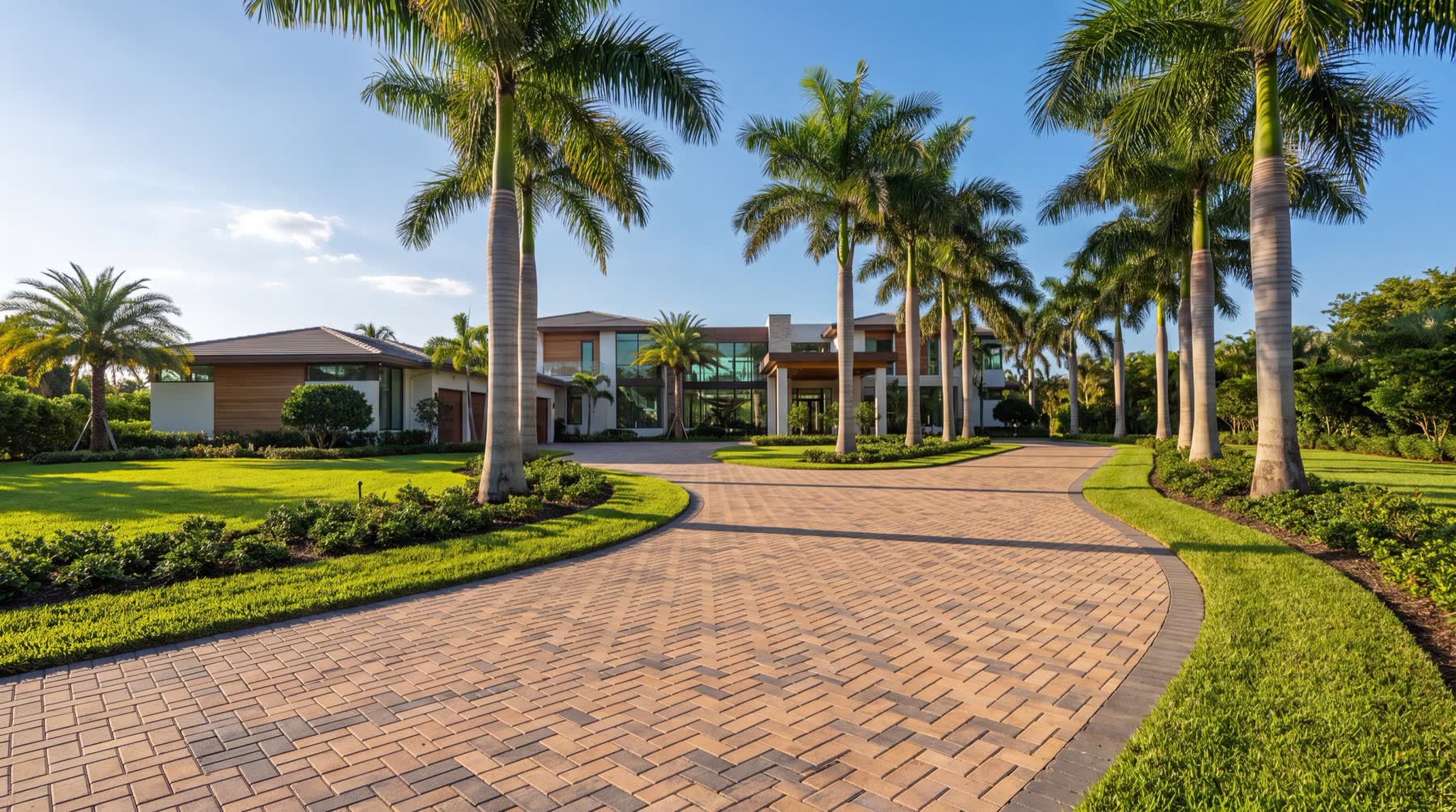
Pattern changes the labor side. A running bond or basketweave lays fast because most pieces are full units with few cuts. Herringbone takes longer to lay because of the angled cuts at every edge — but it's also the pattern that interlocks best under wheel traffic, which is why you'll see it recommended for driveways specifically. The tighter, more cut-heavy the pattern, the more hours it takes to lay the same square footage.
What is edge restraint doing, and why does it change the quote?
Edge restraint is the material anchored along the perimeter of a paver installation to keep the outer pavers from creeping outward under load over time. It has to be fastened into the compacted base, not just set on top of the sand — restraint pinned to sand doesn't hold. Getting this detail wrong is one of the more common ways a paver surface starts spreading at the edges over time.
How much restraint a job needs scales with the perimeter, not the square footage — a long, simple rectangle has less edge to restrain than an irregular shape with curves and cutouts covering the same area. Curved runs also take more attention to install cleanly than a straight line does, which is a labor factor as much as a material one.
Where do size and sealing fit into the number?
Size is the most obvious lever — more square footage means more material and more labor — but it doesn't act alone. The same size job can cost differently depending on the access, base depth, pattern, and edge length that go with it. A large, open, rectangular patio with easy access is a more efficient build than a smaller space with tight access and a lot of pattern cuts.
Sealing is usually its own line item, not folded into the install price, because it happens on its own timeline — the surface has to be clean and fully dry, and often the joint sand needs time to cure first. Ask specifically whether sealing is included in your estimate or scheduled separately, because it's a real cost people sometimes forget to budget for until it comes up later.
Free estimate
Rather just ask us?
Two minutes on the phone usually settles it — or send a photo of the space.
Related questions
What people ask next.
Does a bigger paver job cost less per square foot?
Sometimes — set-up time and equipment mobilization spread across more area, so a larger simple job can be more efficient per square foot than a small one. But a big job with hard access, heavy pattern cuts, or a lot of perimeter to restrain can offset that. Ask for the line-by-line breakdown rather than assuming size alone sets the rate.
Why did two driveways the same size get different quotes?
Because size is only one of several factors. Access, existing base condition, drainage needs, paver line, pattern, and how much edge restraint the shape requires can all differ between two jobs that measure the same. An itemized estimate should show you which of those is driving the difference, not just a total.
Is choosing a cheaper paver line a good way to save?
It's a legitimate lever, since the unit itself is a direct material cost — but check what you're trading. Thickness and load rating matter on a driveway, and lines can wear or hold up differently over time. Ask what the actual difference between lines is, not just that one costs less than another.
Should sealing be part of my install estimate?
Ask specifically — it's often a separate line item scheduled after the joint sand has time to cure, not bundled into install day. Some estimates include a first sealing, some don't. Either is normal, but you want to know which one you're getting before you compare numbers.
Keep reading
Where to go from here.
The service
More guides
Fastest answer
Instant quote — give us a call.
Most questions we can answer on the phone in two minutes, and if we need to see it we'll book the walkthrough while you're on the line.
(321) 586-9227Or text a photo of the space — that's often the fastest way to get a real answer. Prefer email? info@groundworkspaversandturf.com.
Free estimate
Get a written number instead.
Free walkthrough, itemized estimate, no pressure.
Five quick questions — then you're booked in and someone reaches out within 5 minutes. Prefer to talk? Call (321) 586-9227.